The best cat water fountains in the UK (2026)
Seven fountains compared on capacity, filters, noise and cleaning — plus an honest look at whether a fountain will actually get your cat drinking more.
This guide contains affiliate links, each marked with a button. If you buy through one, we may earn a small commission at no extra cost to you. It never changes what we recommend, and we have not been paid to include any product. Prices were checked on 1 November 2026 and change often. As an Amazon Associate I earn from qualifying purchases.
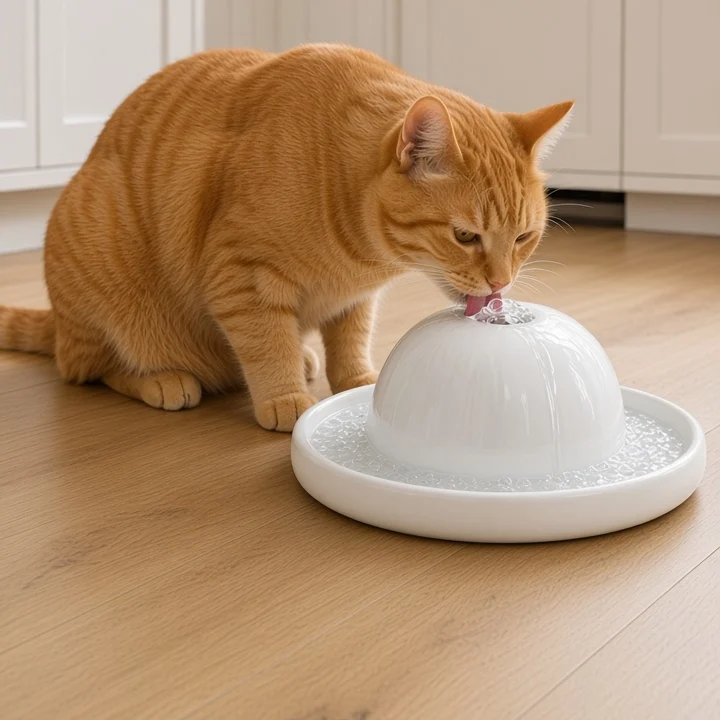
Watch a cat ignore a full bowl and then stretch up to lap at a dripping tap, and you will understand why water fountains exist. Cats evolved to get most of their water from prey and have a weak thirst drive, so anything that makes drinking more appealing is worth a look. International Cat Care notes that some cats prefer moving water, and Cats Protection says many cats like flowing water and suggests a fountain as one way to encourage drinking.
The honest caveat: a fountain is not a guaranteed fix. In a controlled 2018 study of 14 cats fed dry food, average water intake was not significantly different between still, free-falling and circulating bowls — although a few individual cats showed a clear preference. So think of a fountain as a good bet for a cat who seems fussy about still water, not a cure. If your cat is suddenly drinking more than usual, that is a reason to see your vet, not to buy a gadget — our guide to how much water a cat should drink explains why.
Quick picks
- Best overall: Petlibro Dockstream 2 Smart Cordless — 3L, battery or mains, app tracking, quiet magnetic drive.
- Best smart fountain on a budget: Petlibro Dockstream 2 Plug-In — the same design without the battery.
- Best value: Catit Flower Fountain — 3L and three flow settings for around £31.
- Best compact pick: Catit PIXI — 2.5L with a handy low-water light.
- Best for multi-cat homes: PetSafe Drinkwell 360 Stainless — 3.8L with up to five streams.
- Best ceramic: PetSafe Drinkwell Avalon — heavy, easy to clean, and still holds water if the power goes off.
Cat water fountains compared
| Fountain | Capacity | Material | Power | Noise (maker's figure) | Price checked |
|---|---|---|---|---|---|
| Petlibro Dockstream 2 Smart Cordless | 3L | Plastic, stainless tray | Battery (5,200mAh) or mains | 23dB | £99.99 Petlibro · £84.90 Amazon |
| Petlibro Dockstream 2 Plug-In | 3L | Plastic, stainless tray | Mains | 23dB | £89.99 Petlibro · £76.47 Amazon |
| Petlibro Dockstream Smart (original) | 2.5L | Plastic | Mains | 23dB | £85.99 Petlibro |
| Catit PIXI | 2.5L | Plastic, or stainless top | Mains | Not published | £41 (stainless £50) Catit UK |
| Catit Flower Fountain | 3L | Plastic | Mains | Not published | £31 Catit UK |
| PetSafe Drinkwell 360 Stainless | 3.8L | Stainless steel | Mains | Not published | £106.99 Amazon & PetSafe |
| PetSafe Drinkwell Avalon | 2L | Ceramic | Mains | Not published | £83.50 Amazon · £114.99 PetSafe |
Noise figures are the manufacturer's own; we have not measured them. "Not published" means we could not find an official figure.
The reviews
1. Petlibro Dockstream 2 Smart Cordless — best overall
The Dockstream 2 holds 3 litres and can run either from its 5,200mAh battery or on mains power, so you can put it somewhere with no socket nearby. Petlibro quotes "up to 30 days" per charge, but that is a lab figure for one cat drinking about 40 times a day in sensor mode — expect less with continuous flow or several cats. It uses a pump-free magnetic drive, which Petlibro rates at 23dB, and a four-layer filter that should be changed every two weeks. The app logs drinking for one pet over 2.4GHz or 5GHz Wi-Fi.
Pros: runs cordless; quiet by design; dishwasher-safe stainless tray; sensor or continuous flow.
Cons: the most expensive pick here; filters every two weeks add up (4-pack £19.99); only the tray is dishwasher-safe.
Best for: single-cat homes that want drinking data or a fountain away from a socket.
Petlibro Dockstream 2 Smart Cordless — £99.99 at Petlibro UK, £84.90 on Amazon UK when checked.
Check Amazon UK →2. Petlibro Dockstream 2 Plug-In — the smart fountain for less
This is the same 3L Dockstream 2 design, minus the battery. You keep the magnetic-drive, pump-free design, the 23dB rating, continuous or intermittent flow, app tracking and a 304 stainless steel tray and filter tray that both go in the dishwasher. If your fountain will sit next to a socket anyway, it is the better buy.
Pros: cheaper than the cordless version; dishwasher-safe stainless tray and filter tray; app features retained.
Cons: needs a socket; same two-weekly filter cost.
Best for: anyone who likes the Dockstream 2 but does not need cordless running.
Petlibro Dockstream 2 Plug-In — £89.99 at Petlibro UK, £76.47 on Amazon UK when checked.
Check Amazon UK →3. Petlibro Dockstream Smart (original) — smaller and lighter
The first Dockstream is a 2.5L mains fountain weighing just 858g, with an induction-driven pump, the same 23dB claim and a four-layer filter changed every two weeks. Its app connects over 2.4GHz Wi-Fi only. Petlibro itself recommends it for single-cat homes.
Pros: compact; app monitoring; bundles with 4 or 8 filters (£98.99 / £110.99) save on spares.
Cons: smaller capacity; corded only; little cheaper than the newer Plug-In.
Best for: one cat and a smaller kitchen.
Petlibro Dockstream Smart — £85.99 at Petlibro UK when checked. This is a plain link to Petlibro, not an affiliate link.
See it at Petlibro →4. Catit PIXI — best compact pick
The PIXI holds 2.5L in a 20.5cm-wide footprint and has three flow options. Its "nose" light doubles as a low-water warning and a night light, and the pump switches off automatically when the water runs low. Catit's Triple Action filter combines a cotton mesh, activated carbon and ion-exchange resin. The stainless steel-top version has a dishwasher-safe top.
Pros: low-water light; auto shut-off; cheap filters (3-pack £6).
Cons: no published noise figure; plastic body on the standard model.
Best for: one or two cats, smaller spaces, and owners who forget to top up.
Catit PIXI — £41 (plastic) or £50 (stainless top) from Catit UK when checked. The Amazon UK listing had no featured offer when we checked, so check the price before you buy.
Check Amazon UK →5. Catit Flower Fountain — best value
A long-standing favourite for good reason: 3L of water, three adjustable flow settings and the same Triple Action filter type as the PIXI. The LED version costs £34.
Pros: the cheapest 3L fountain here; flexible flow; inexpensive filters (2-pack £7.20).
Cons: all-plastic; no published noise figure; the flower top has more nooks to scrub.
Best for: trying a fountain without a big outlay.
Catit Flower Fountain — £31 from Catit UK when checked. The Amazon UK listing had no featured offer when we checked.
Check Amazon UK →6. PetSafe Drinkwell 360 Stainless — best for multi-cat homes
At 3.8L, this is the largest fountain we compared, and its one to five adjustable streams let several cats drink at once from different sides. The stainless bowl goes in the dishwasher (top rack), and filtration is a carbon filter plus a foam pre-filter, replaced every two to four weeks.
Pros: big capacity; drinking points all round; stainless steel bowl.
Cons: large footprint (37cm across); submersible pump needs regular cleaning; no published noise figure.
Best for: two or more cats, or longer gaps between top-ups.
PetSafe Drinkwell 360 Stainless — £106.99 on Amazon UK and at PetSafe when checked.
Check Amazon UK →7. PetSafe Drinkwell Avalon — best ceramic
A 2L ceramic fountain with two streams. It weighs 2.71kg, so it is hard to knock over, and the open bowl still holds water if the power cuts out. The raised dish may also suit older cats who find bending down uncomfortable.
Pros: ceramic surfaces; stable; still works as a bowl without power.
Cons: smaller 2L capacity; heavy to carry to the sink; no published noise figure.
Best for: owners who prefer ceramic, and senior cats.
PetSafe Drinkwell Avalon — £83.50 on Amazon UK, £114.99 at PetSafe when checked.
Check Amazon UK →How to choose a cat water fountain
Size and capacity
For one cat, 2–2.5L is plenty if you refresh it every few days. For two or more cats, go for 3L or more and put out a second water point — International Cat Care suggests one water bowl per cat plus one extra.
Filters and running costs
Budget for filters as well as the fountain. Petlibro recommends a new filter every two weeks (about £4–5 each in a 4-pack), PetSafe every two to four weeks, while Catit's are cheapest per pack. Check that replacements are easy to buy in the UK before you commit.
Noise
Some cats are wary of a humming pump. Magnetic-drive designs such as the Dockstream are rated very quiet by their maker, but most brands do not publish a figure. Whatever you buy, keep the water topped up — a pump running low on water tends to get noisier.
Cleaning
All fountains need stripping down regularly, including the pump. Look for dishwasher-safe parts and fewer crevices. A fountain that is a chore to clean will end up dirty, and that defeats the point.
Ceramic, stainless steel or plastic?
International Cat Care says cats generally prefer glass or ceramic to plastic, and Cats Protection notes that plastic or metal can taint water. Ceramic is heavy and easy to clean but can chip; stainless steel is tough and dishwasher-friendly; plastic is cheapest and lightest but scratches more easily over time.
Placement
Keep the fountain away from the food bowl — cats prefer to drink away from where they eat — and well away from the litter tray. Introduce it gradually, ideally alongside the old bowl at first.
How old is your cat in human years?
Older cats are more prone to dehydration and kidney problems. Check their life stage in seconds.
Open the cat age calculator →A change in drinking or litter habits can be an early sign of illness. If your cat suddenly drinks a lot more or less, speak to your vet. Litter box problems explained →
Common questions
Do cats drink more from a water fountain?
Some do. Many cats seem to prefer moving water, but a controlled study found no significant average difference in intake between still and circulating bowls, though individual cats had clear preferences. It is worth trying, alongside wet food and extra water stations.
How often should I clean a cat water fountain?
Follow the maker's instructions, but plan on a full strip-down and clean every week or two, including the pump, and change the filter on schedule — every two weeks for Petlibro, every two to four weeks for PetSafe.
Is a ceramic or stainless steel fountain better than plastic?
International Cat Care says cats generally prefer glass or ceramic to plastic. Ceramic and stainless steel are also easier to keep clean, as they do not scratch as readily as plastic.
Are cat water fountains noisy?
Most are quiet, but pump noise varies and few brands publish a figure. Petlibro rates its Dockstream fountains at 23dB. Keeping the water level topped up helps keep any pump quieter.
Can I use tap water in a cat fountain?
Yes, ordinary drinking-quality tap water is fine. The filter helps remove hair and debris, and regular cleaning stops limescale and slime building up on the pump.